

Renewable Energy-Powered Seawater Desalination Equipment
Freshwater scarcity has become an important challenge in many coastal regions, islands, and remote areas. Although seawater covers most of the Earth's surface, converting seawater into usable freshwater requires advanced treatment technology and significant energy input.
seawater reverse osmosis (SWRO) is one of the most widely used desalination technologies because of its high efficiency and flexible application range. However, the high-pressure pumps required for SWRO operation consume considerable electricity, making energy supply an important factor in desalination system design.
Renewable energy-powered Seawater Desalination equipment provides an alternative approach by combining SWRO technology with solar power, wind energy, energy storage systems, and intelligent control technologies. This integration helps reduce dependence on conventional electricity sources and enables reliable freshwater production in areas with limited infrastructure.
Modern renewable energy desalination systems are designed to balance energy generation, water production demand, and equipment operation stability. Through optimized system integration, these solutions are increasingly applied in islands, remote communities, offshore facilities, and coastal industrial projects.
Why Renewable Energy Is Used for Seawater Desalination
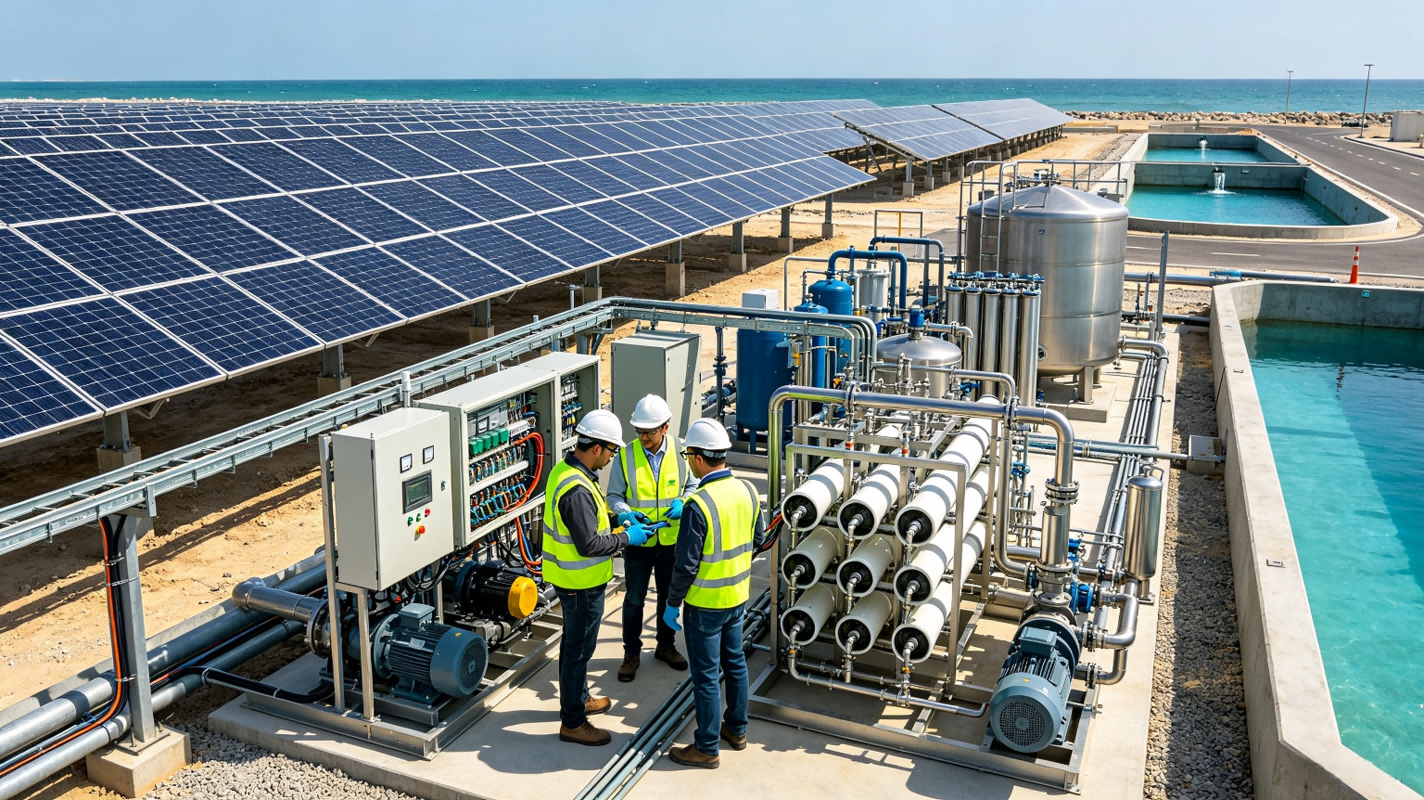
The SWRO process requires seawater to pass through semi-permeable membranes under high pressure. The high-pressure pump is one of the main energy-consuming components in the desalination process.
Energy demand is influenced by:
Seawater salinity
Operating pressure
Water temperature
Recovery rate
System capacity
Membrane performance
Reducing energy consumption has become a major focus in modern desalination engineering.
Renewable energy-powered desalination systems combine clean energy generation with water treatment technology.
Main advantages include:
Solar and wind energy can provide power for Desalination Equipment, especially in areas where grid connections are limited.
Many islands and coastal regions have abundant renewable energy resources but limited freshwater availability.
Renewable power integration helps optimize long-term desalination operation.
Renewable energy systems can be configured according to local conditions, including solar availability, wind resources, and water demand.
Main Components of Renewable Energy-Powered Desalination Systems
A renewable energy desalination system usually consists of several integrated units.
The energy source provides electricity for desalination equipment.
Common renewable energy sources include:
Solar photovoltaic panels
Wind turbines
Hybrid solar-wind systems
The selection depends on local climate conditions and project requirements.
Solar energy is one of the most common renewable power sources for small and medium-scale desalination systems.
A solar-powered SWRO system typically includes:
Photovoltaic modules
Solar inverters
Power management equipment
Battery storage systems
Electrical control systems
Solar energy is converted into electricity to operate:
Seawater pumps
Pretreatment equipment
High-pressure pumps
Control systems
Wind power can be integrated into desalination projects located in areas with stable wind conditions.
Wind-powered desalination systems may include:
Wind turbines
Power conversion equipment
Energy storage systems
Control units
Wind energy can complement solar power by providing electricity during different operating periods.
Renewable energy output naturally changes according to weather conditions.
Energy storage helps maintain stable desalination operation.
Common storage solutions include:
Battery systems
Hybrid energy storage systems
Power management units
Energy storage supports:
Continuous equipment operation
Power fluctuation control
Load management
Integration of Renewable Energy and SWRO Systems
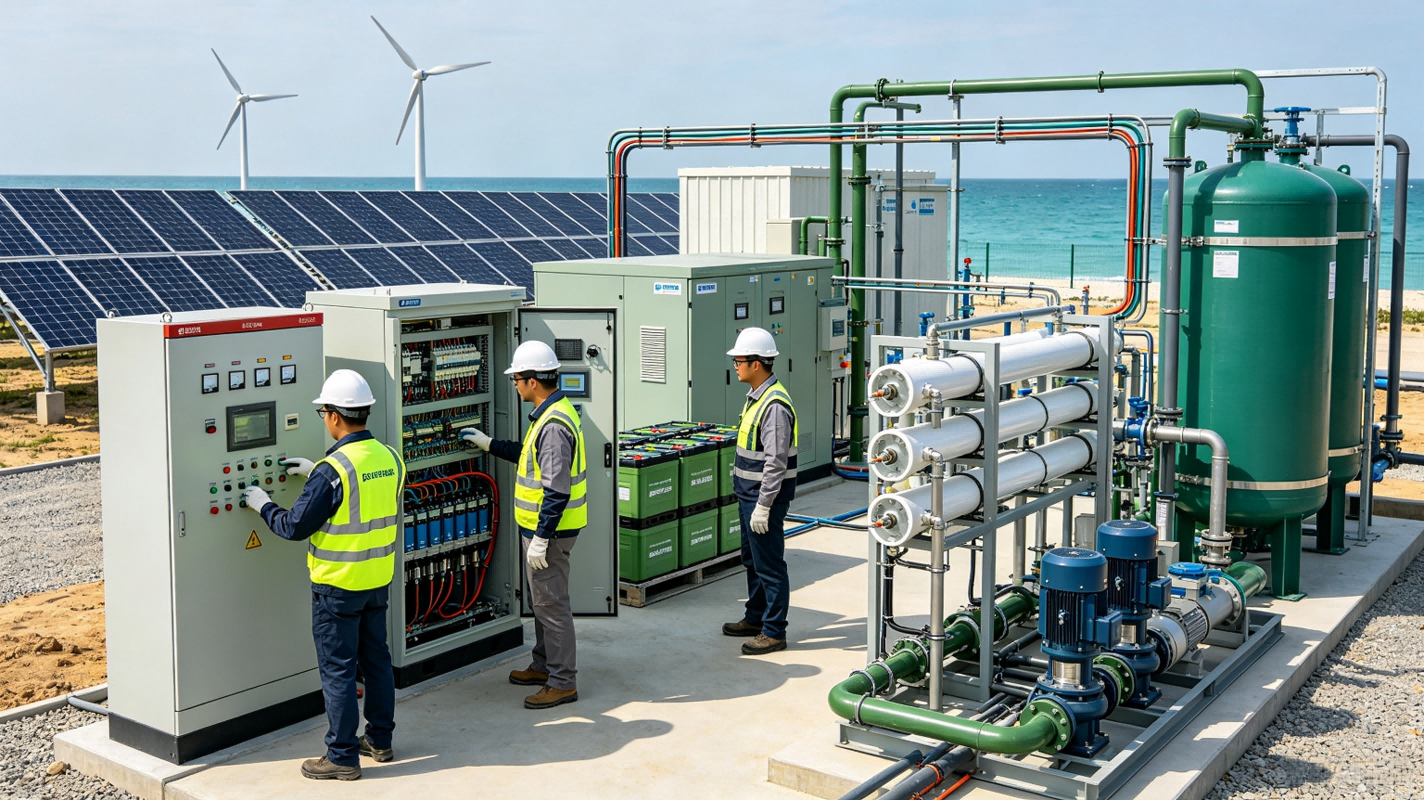
Renewable energy systems must be carefully matched with SWRO equipment.
Important design factors include:
Energy generation capacity
Desalination production requirements
Pump power demand
Operating schedule
Storage capacity
A well-designed power management system ensures stable operation.
Renewable energy systems are often combined with efficient SWRO components.
Important equipment includes:
High-efficiency high-pressure pumps
Energy recovery devices
Low-energy RO membranes
Automated control systems
Energy recovery technology is particularly important because it reduces the electricity required by high-pressure pumping.
Smart control technology coordinates renewable energy generation and desalination operation.
The control system can monitor:
Renewable power availability
Battery charging status
Pump operation
Water production
Energy consumption
Based on available energy, the system can adjust operating conditions to maintain efficient performance.
Solar-Powered SWRO Desalination Equipment
Solar-powered SWRO systems are widely used in areas with strong solar resources.
A typical solar desalination system includes:
Solar power generation
Electrical conversion
Seawater intake
Pretreatment
High-pressure pumping
RO membrane separation
Freshwater storage
The system converts solar energy into electricity and uses it to produce freshwater from seawater.
Applications include:
Island communities
Coastal villages
Remote industrial sites
Emergency water supply projects
Off-Grid Renewable Energy Desalination Systems
off-grid desalination systems are designed for locations without reliable electricity infrastructure.
Typical applications include:
Small islands
Remote coastal areas
Marine facilities
Disaster response areas
Important design considerations include:
containerized SWRO systems can integrate:
Pretreatment units
RO equipment
Pumps
Control cabinets
Energy management systems
into a transportable module.
Remote systems require:
Automated control
Remote monitoring
Simple maintenance procedures
Durable equipment design
Because renewable energy availability changes, water storage helps balance production and demand.
Storage tanks allow freshwater availability during periods of lower energy production.
Applications of Renewable Energy-Powered Desalination
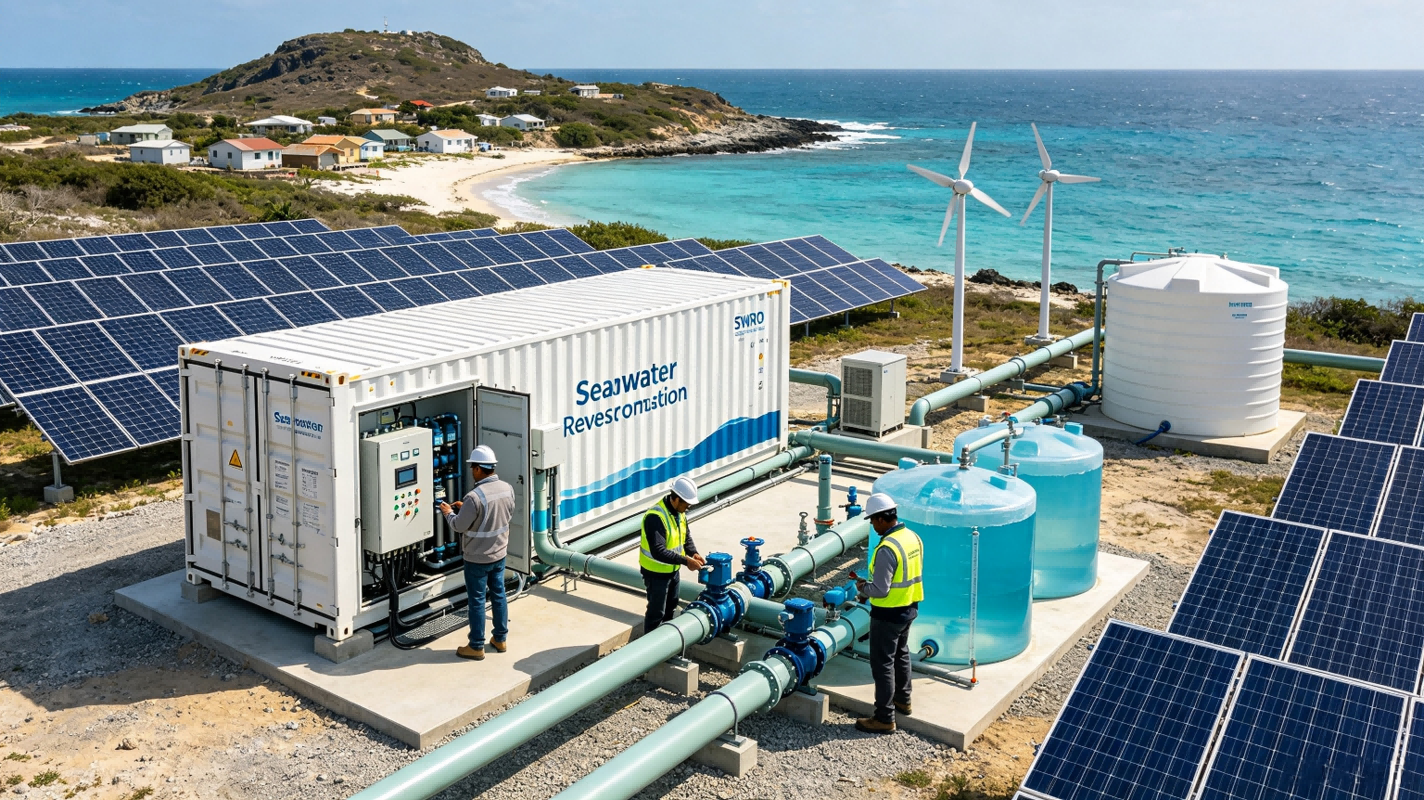
Many islands face freshwater shortages but have abundant solar and wind resources.
Renewable SWRO systems can provide:
Drinking water
Hotel water supply
Community water supply
Emergency water resources
Remote areas may lack reliable power infrastructure.
Renewable desalination equipment provides an independent freshwater solution without requiring large-scale grid expansion.
Offshore platforms and marine facilities require reliable freshwater sources.
Renewable energy systems can support:
Personnel water supply
Equipment operation
Marine applications
Some coastal industries require large amounts of freshwater.
Renewable energy integration can help improve energy management in industrial desalination projects.
Challenges of Renewable Energy Desalination Systems
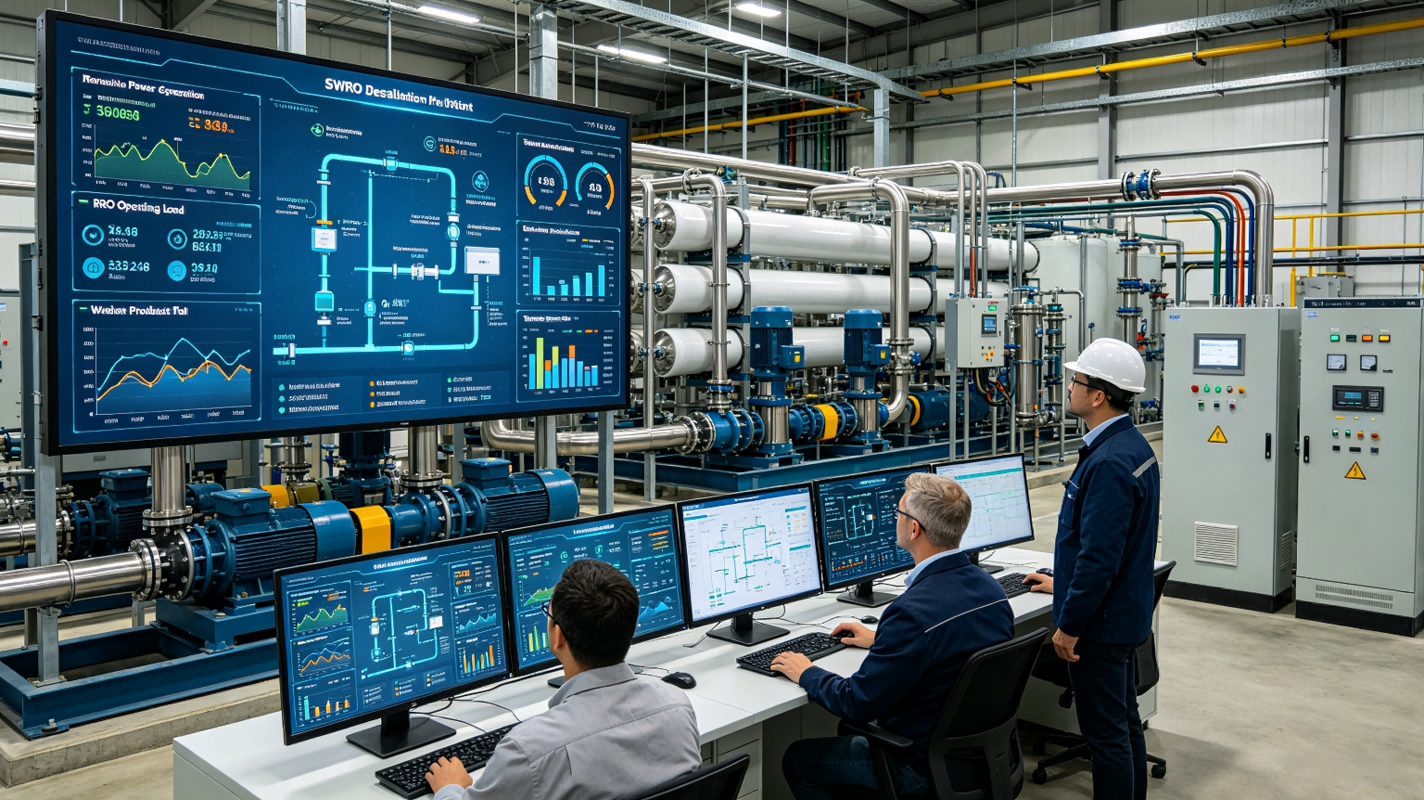
Although renewable energy offers many advantages, system design must consider several challenges.
Solar and wind output changes due to:
Weather conditions
Seasonal variations
Daily cycles
Energy storage and intelligent control help manage these fluctuations.
Engineers need to balance:
Energy production
Water demand
Equipment capacity
Operating costs
Oversized or undersized systems may reduce overall efficiency.
Marine environments can create challenges such as:
Salt exposure
Humidity
Corrosion risk
Equipment selection should consider corrosion-resistant materials and reliable protection measures.
Smart Energy Management in Renewable Desalination Plants
Smart energy management improves coordination between renewable power systems and desalination equipment.
Functions include:
The system tracks:
Solar generation
Wind power output
Battery status
Equipment energy consumption
The system can adjust desalination operation according to available energy.
Examples include:
Increasing production during high solar output
Reducing load during low energy availability
Historical operating data helps improve:
Energy efficiency
Maintenance planning
Production management
Maintenance of Renewable Energy Desalination Equipment
Regular maintenance ensures long-term system reliability.
Important maintenance tasks include:
Check:
Power generation performance
Electrical connections
Equipment condition
Inspect:
Pumps
RO membranes
Valves
Sensors
Control systems
Monitor:
Battery performance
Charging efficiency
Safety conditions
Future Development of Renewable Energy Desalination
Renewable energy-powered desalination will continue developing with improvements in:
High-efficiency membranes
Advanced energy recovery devices
Battery technology
Intelligent control systems
Hybrid renewable energy solutions
Future desalination systems are expected to achieve better coordination between energy generation and freshwater production.
The combination of renewable energy and SWRO technology provides a practical pathway for producing freshwater in regions where traditional energy infrastructure is limited.
Conclusion
Renewable energy-powered seawater desalination equipment combines SWRO technology with solar power, wind energy, energy storage, and intelligent control systems to provide sustainable freshwater production solutions.
By reducing dependence on conventional electricity and improving energy management, renewable desalination systems support water supply in islands, remote communities, offshore facilities, and coastal industries.
Successful project implementation requires careful consideration of seawater conditions, energy resources, equipment efficiency, storage capacity, and system control.
As renewable energy technologies continue to advance, integrated renewable-powered desalination systems will play an increasingly important role in reliable and efficient freshwater production from seawater.
אתר זה משתמש בקובצי Cookie כדי להבטיח שתקבל את החוויה הטובה ביותר באתר שלנו.
 English
 Portugues
 Pусский
 Français
 العربية
 ไทย
ไทย Indonesia
 Melayu
 Tiếng Việt
 中文
中文 қазақ
қазақ မြန်မာ
 ພາສາລາວ
 Filipino
 o'zbek
 Кыргызча
 тоҷикӣ
 ខ្មែរ
ខ្មែរ Türkmenler



 טֵלֵפוֹן
תגובה
(0)